
2025 Wrap-Up: Energy, Policy, and Predictions Revisited
We’re closing out the year with our final podcast of 2025, looking back at the biggest stories and revisiting the predictions we made at the start of the year. How did we do?
2025 delivered volatility and plenty of surprises, along with a long list of developments with real consequences for energy, both clean energy and traditional oil and gas. We cover major policy shifts, including the election of the Mark Carney Liberals in Canada, the introduction of Bill C-5, the launch of the Major Projects Office, the Ottawa–Alberta Memorandum of Understanding (MOU), and growing political support for LNG.
We also review changes in the United States, including tariffs and the One Big Beautiful Bill (OBBB), which rolled back many of America’s generous clean energy subsidies.
Another recurring theme this year was the surge in expectations for AI data center electricity demand—including in Canada, where three proposed projects in Alberta are moving closer to a final investment decision.
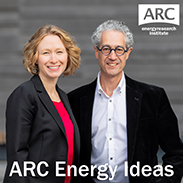
It’s been a whirlwind year. Jackie and Peter wish everyone a wonderful holiday break, and we’ll return in 2026.
Content referenced in this podcast:
- The Hub.ca, Have we really hit peak oil? Please don’t count on it (December 2, 2025)
- National Security Strategy of the United States of America (November 2025)
Please review our disclaimer at: https://www.arcenergyinstitute.com/disclaimer/
Check us out on social media:
X (Twitter): @arcenergyinst
LinkedIn: @ARC Energy Research Institute
Subscribe to ARC Energy Ideas Podcast
Apple Podcasts
Amazon Music
Spotify
Episode 307 transcript
Disclosure:
The information and opinions presented in this ARC Energy Ideas podcast are provided for informational purposes only and are subject to the disclaimer link in the show notes.
Announcer:
This is the ARC Energy Ideas podcast, with Peter Tertzakian and Jackie Forrest, exploring trends that influence the energy business.
Jackie Forrest:
Welcome to the ARC Energy Ideas Podcast. I’m Jackie Forrest.
Peter Tertzakian:
And I’m Peter Tertzakian and welcome back. Welcome back to the last podcast of the year. We are now solidly past Black Friday, Cyber Monday, and rolling into the holiday season with Christmas is the next big marker here. Got your shopping done?
Jackie Forrest:
No, no, but I don’t do too much this year. I kind of convinced everyone not to get presents.
Peter Tertzakian:
Yeah. Yeah. Well, I’m looking forward to shopping mall Wednesday. That’s the next date. That’s the 24th. That’s when-
Jackie Forrest:
Oh, that’s when you wait to get your-
Peter Tertzakian:
Yeah, of course.
Jackie Forrest:
That’s smart, Peter.
Peter Tertzakian:
I’m coining the new term. Okay. Well, last podcast of the year, it’s traditionally when we look back. We look back at the forecasts we made at the beginning of the year. And I don’t know, Jackie, there’s like 10 pages of stuff here. There’s so much that happened this year politically in the economy with energy. I mean, it’s just crazy. So shall we get started?
Jackie Forrest:
Yeah. Well, as I look back, I kept saying to myself, “Did that all really happen this year? Was that only a year ago?” So hopefully we can try to get through this in a decent amount of time. But I did want to start off with the markets. If we go back to the beginning of this year, there was a real concern that tariffs were going to create a slower economy, but the markets have roared. The S&P 500 is way up. The Magnificent 7, the big IT companies are way up. And so generally, people have done a lot better on the markets than people would’ve thought a year ago.
Peter Tertzakian:
Yeah, certainly the AI trade has been huge and that’s been pulling up the markets. Things are looking a little more fragile as we head into 2026, but there was a lot of predictions that were made early on in 2025 that, “Whoa, watch out.” And I know even going into mid-year, there was a lot of the bank analysts that were forewarning of recession and market bubble and so on and so forth. And to this point, it hasn’t happened. I mean, if you wait long enough, something’s going to happen. But to this point, I mean, the markets have been incredibly … What are the numbers here?
Jackie Forrest:
Yeah, up about 20%. The S&P is up about 16% year to date right now as we record and the Magnificent 7 up 22%. The other thing that hasn’t really gone as people thought is inflation. A lot of people expected US would have a lot of inflation because of all the tariffs, but the latest data from US inflation is still in the 3% range, which is a little bit elevated from the target of two, but still not extreme compared to what we experienced after COVID.
Peter Tertzakian:
But having said that, a lot of the tariffs now have carve outs and exceptions and some of them haven’t even yet to be resolved, including the Canadian ones. So there was a lot of bluster for sure for the first half of the year as we rolled into the second half of the year. Exactly how much the tariff burden really is, is open to debate. There are numbers out there, but generally speaking, you’re right. The inflation numbers and the prognostications for the market have not played out. Not to say that there aren’t structural problems underneath and that those structural problems are not differential. In other words, the AI trade is far different than the trade for other things, including energy, which we will come to.
Jackie Forrest:
That’s right. Well, let’s start with our forecast.
Peter Tertzakian:
Yeah.
Jackie Forrest:
Beginning of this year, we talked about what could happen in the upcoming year. And I have a quote from you to start off the podcast from last year.
Peter Tertzakian:
I better buckle up. Okay.
Jackie Forrest:
You said, “2025 will no doubt be a period of a lot of change and volatility, not only domestically, but in terms of what happens post the inauguration of President Trump and other things around the world that are looking very volatile at the moment.” So you got that one right.
Peter Tertzakian:
Yes, I did. Except that I think I want to probe the word volatile a little bit more as we get into this conversation and we get into the conversation about predictions that materialize, because volatility is a measure of statistical deviation from some average. What we talked about in 2025 is that things are unpredictable. And I want to explore that a little bit more because unpredictability is different from volatility. As we go into 2026, I say that we’re going to have a lot more unpredictability, which will then lead to volatility in the markets.
Jackie Forrest:
And maybe people not spending as much and other kind of knock-on effects. Okay. Before we get into that though, because we’re not going to do predictions on this podcast, that’s going to be first one of 2026. We did about nine predictions on our podcast, and I rate us as about 60% correct, so not bad. The year before, we were 65% correct, but considering such an unpredictable volatile year, I think we did pretty well.
Peter Tertzakian:
Okay.
Jackie Forrest:
More than 50.
Peter Tertzakian:
I know that 60% may be debatable, right?
Jackie Forrest:
Yeah. Well, we’ll get into my marketing system.
Peter Tertzakian:
Whether or not your marketing system is adequate depending upon whether it’s your prediction or mine.
Jackie Forrest:
Okay. So our first prediction is we’re going to be talking a lot about Donald Trump, tariffs, clean energy subsidies, even what he’s going to do to the Canadian dollar because at that time we were really concerned about big tariffs on Canada. So I think we mostly were right on that.
Well, the tariffs weren’t as bad as we thought maybe at the beginning of the year. At the beginning of the year, Trump was talking about 25% tariffs on most goods and maybe as soon as March 4th. That didn’t happen. Most of the goods in Canada are now free of the tariffs. That can still change again, but right now most of them are following under our free trade agreement, but certainly there are tariffs on certain sectors like steel, aluminum, copper, and lumber.
The one thing that we talked about at the beginning of the year is concern around the value of the Canadian dollar. The Canadian dollar actually did fairly well, about 70 cents most of the year. But what really changed was the US dollar actually weakened. JP Morgan talked about the value of the US dollar dropping about 10% versus a basket of currencies. And so the Canadian dollar looked like it did better. Relative to the US, it stayed okay, but relative to many other currencies, it was-
Peter Tertzakian:
Yeah, there was a lot of doom and gloom around on the dollar at the beginning of this year, but it seemed to hang in there somewhat. Although if you go back to 2024, it was in the mid 70s and now we’re in the low 70s, around 71 and a half or so. Okay. But the other part of this prediction where we’re going to be talking a lot about weaker clean energy subsidies and so on, I think neither of us predicted. In fact, a lot of people did not predict the extent to which the Trump administration would take the wrecking ball to things like the IRA and the clean energy. It’s almost like a vendetta against wind and solar and anything renewable.
Jackie Forrest:
Yeah. So we did know that he’d already signaled that clean energy would sort of be in the crosshairs, but yeah, the extent was pretty extreme. Now, I will say some areas were spared, like manufacturing of clean energy technology still did well, and they did allow some grandfathering. So over the next several years, as projects that started construction, they still get to take advantage of some of those clean energy subsidies. But certainly, the US is not as favorable as it was. And that’s actually an advantage to Canada because we have our investment tax credits and we are having trouble competing with the Americans. And so in many cases, Canada is looking like a better destination.
Peter Tertzakian:
It is for the moment. I mean, I think that getting back to the unpredictability of what’s happened because I view the unpredictability relative to what a lot of pundits we’re talking about is, for example, oh no, they won’t touch this part of the Inflation Reduction Act or this green energy subsidy because it’s in a red state and red states are safe. But actually, pretty much the entire policy has been trashed.
Jackie Forrest:
Well, yeah, except for some key areas like CCS and manufacturing.
Peter Tertzakian:
Yeah, as you said, manufacturing, but still, the extent to which this happened is really quite severe and not predicted. You want to move on to number two?
Jackie Forrest:
Okay. Talking about not predicting. So this is one that we were really off on. We get zero score for this. We predicted that absolutely the Conservative Party of Canada would form the next government. And we even had a discussion, there was rumors at the time that Mark Carney might run, but we still didn’t think that he could win because there was a 20% gap in the polls between the conservatives and the liberals. So conservatives had something like 45% support and the liberals were closer to 20%. Well, things really did change. Obviously, we got a minority government. Well, minority for now, by the way. It may change out there.
Peter Tertzakian:
It may change, and we can talk about that as well. But I think this brings about an important lesson for me personally, because why did we think that Pierre Poilievre would win resoundingly when Mark Carney was sort of lurking in the wings, ready to take on the Liberal Party, and then ultimately win the minority election?
Certainly for me, it was because there was a lot of polls and pundits that said, “Oh, there’s no way that Pierre Poilievre and the CPC could lose with this sort of a big gap in the polls.” And I got to tell you, in my gut feel was, okay, well, I always like to question things and I’m kind of thinking when it’s too good to be true, you really got to question even harder.
And there’s been points in my history of trying to predict events as an analyst where I have this gut feeling that what everybody else is saying should be questioned. That there’s this broad momentum of consensus that it seems like we all have to follow. And for me, the lesson is, as we go into these unpredictable years that are still ahead of us, is just question everything. Even if overwhelmingly and resoundingly pundits and pulsers say, “This is guaranteed almost because look at the momentum or the margin and stuff.” I think the minute you get people talking about certainty is the minute that you really need to be questioning.
Jackie Forrest:
Yeah. It’s just like another thing I’ve learned on the years is the extremes, right? Things are never as bad as they seem when you’re thinking that they’re going to be bad or as good as they seem. And this is another one where it seemed when it’s as so good, you have to question what are the things you’re missing. So, yeah, we missed that one.
Another one that we didn’t miss though was growing electricity demand in Canada was going to be a big discussion in 2025 and how AI was pushing those outlooks higher. So we’ve had many podcasts on that topic. We also had concern that Canadian electricity regulation, which had just come out as a final rule around the same time as we released the podcast was going to be a problem for meeting this load growth. And that’s certainly something we’ve talked about. And now with the Alberta and Ottawa MOU, there’s a chance maybe that policy is going to be softened not only in Alberta, but in other jurisdictions.
Peter Tertzakian:
Well, certainly the concern about the CER and how it would inhibit capital spending by power generators was a major concern that played out in 2025. And we’re now seeing some announcements as we go into 2026 on the basis. So the CER is going to be axed, at least in Alberta, is a positive signal.
Jackie Forrest:
Yeah, we’ll get to that, but we’ve had some announcements around AI data centers and that is a positive change of events. Another prediction we made was the return of energy security and sovereignty, including that Canada would prioritize non-US pipelines. So got full marks on that. I think even bonus points, because I tell you, the beginning of 2025, I don’t think I would’ve been very bullish that at the end of the year, I’d be saying, “We’re probably going to have six BCF per day of LNG exports off our West Coast by the early 2030s and maybe even a one million barrel a day oil pipeline.” So it was even better maybe than I expected. I think we were talking about it, but actually having the idea that we’ll see real projects being built.
Peter Tertzakian:
Right. And even if it isn’t a one million barrel a day new pipeline, the expansion of Trans Mountain beyond, it’s already in service capacity of, what is it, 800,000 or 900,000 barrels per day additionally is something that was part of this prediction.
Jackie Forrest:
That’s true. And that’s new information this year. We hadn’t thought about that when we had the podcast. We also correctly predicted that LNG Canada Phase 1 would start up. I didn’t really give us points for that one. It was kind of an obvious one. But we also said that we would have a podcast on that topic in 2025, and we just came under the line on that piece by having the podcast last week with Chris Cooper joining us, telling us all about the LNG Canada startup.
Peter Tertzakian:
I mean, it’s had already a big difference on our natural gas prices.
Jackie Forrest:
Well, they’ve really increased. Now, we still have a lot of inventory of gas, but yes, the spot price and the strip price is up almost double what it was for the first 11 months this year.
Peter Tertzakian:
Yeah. I mean, if you look at the numbers, AECO, the hub in Southeastern Alberta where natural gas is priced in Canada or dominantly priced in 2024 averaged $1.36 per gigajoule Canadian, $1.36. 2025, the first month average was $1.50, so barely above 2024, but already the futures curves for the prices in 2026 are $3 plus, so double what they are.
Jackie Forrest:
Yeah, significant. And just to put it in perspective, the gas industry in Canada generated something like $12 billion of revenue we expect in 2025, so we’re going to double that. That’s really consequential. That’s $10 billion in our company.
Peter Tertzakian:
It usually comes with connections to royalties and taxes.
Jackie Forrest:
Yeah. Well, and to just the companies and their profitability and their ability to invest more. So we were giving a lot of value away to the Americans, which was a big theme this year by not having alternatives.
Peter Tertzakian:
For those in our listening audience that are trying to put $1.36 and a $1.50 Canadian for our natural gas prices into context, I just want to point out, the prices in the United States were $3 American, and this just speaks to what we talked about on some of our podcasts mid-year about being a market hostage and leaving so much money on the table and basically not maximizing the revenue of our valuable resources, which ultimately not only affects corporate revenues, but therefore then also affects royalties and tax take.
Jackie Forrest:
It’s really not a nice to have. We really should have these pipelines just so that we can get the most for our natural resources. And I don’t care what your opinion is on the future of oil and gas or how long it’ll be around, but we should be getting the most for our resources while there’s lots of demand for them, and which I think will be for a long time.
Peter Tertzakian:
Right. Okay. What’s number six?
Jackie Forrest:
Okay. Number six, Peter, you predicted that net zero 2050 would disappear and be replaced by something else. So I gave you a partial yes because there’s certainly less momentum towards net zero. We’ve seen this with progress at COP. We saw that with the IEA coming out with the current policy scenario that actually shows oil and gas demand going up for the next 25 years. So there has been a little bit of change, but net zero is certainly in this country still around.
Peter Tertzakian:
Well, I’m going to argue with you because I don’t think it’s a little bit of change. I think net zero by 2050, and maybe I didn’t specify jurisdiction, but is completely gone in the United States and the United States is our major competitor. It’s not even on the radar, and I think it’s replaced by something else, which is basically no targets.
So I think jurisdictionally, if it was a prediction about the United States, I would get full marks. Now, I agree here, the concept is not completely gone, nor is it in Europe, but it’s certainly diminished, whereas it was top of mind and even issues about achieving net zeros as it relates to mitigating climate change were very high amongst people in the polls. It’s precipitously dropped, not surprisingly, when things like affordability, sovereignty, and other types of issues that have come up as we know this here take front and center.
So I agree, it’s a partial yes, but I still think the whole concept of net zero by 2050 is on its way out, not the least of which the reason is because it’s not achievable. And a lot of people have come out in 2025 and said, “You know what? This was not achievable anyway because of the aggressive timelines around the world.”
Jackie Forrest:
I’ll agree with you with that. It’s not achievable. And of course, things like affordability, military spending, worrying about the tariff wars. These are other things that politicians have on their list of things. But here in Canada, it still seems to be a pretty big part of policy as we saw with that MOU. I don’t know how many times net zero 2050 was written in that MOU with the Alberta and Ottawa. It was there numerous times.
Peter Tertzakian:
Yeah. Well, we’ll see. I mean, this is a competitive world if we’re talking about competitiveness. And I think 2026 is the year for Canada when we will try and quantify this nebulous word that people keep throwing around, which is competitiveness. Like what are we talking about, carbon competitiveness versus business competitiveness? We’re going to have to flush out what these words mean numerically, and it is going to be crucial to the failure or success of the MOU, which will be resolved midyear.
Jackie Forrest:
And crucial to attracting a lot of capital here from other jurisdictions, because we have to be a competitive place where they can get a return on their investment too.
Peter Tertzakian:
Okay. Next.
Jackie Forrest:
All right. Well, let’s talk about other events that shaped the year that we didn’t have in our predictions. That was the end of our prediction section. I thought we could just quickly go through some of the high level events that happened because it certainly was a lot. It was really a big year. I already mentioned the tariffs, so we don’t have to go into too much detail, but I will just remind everyone that today, about 85% of Canada goods to the US are still tariff-free, including on energy and oil and gas.
And we were quite worried at the beginning of the year, especially in that February timeframe, that we might see a 25% tariff on Canadian oil, which would add about $25 billion if we had to pay for that, if it fell on Canadian producers to sell their oil for less money in a year. So that didn’t happen, thank goodness. However, I am concerned a little bit about what’s coming in 2026. We’ll have that on our forecast call, but could we see more tariffs come back as part of that renegotiation of the free trade agreement, which has really helped us. Most other countries are paying 13% to 15% type tier tariffs on everything.
Peter Tertzakian:
Well, and that’s not to diminish the pain being felt by steel, aluminum, and we should not forget even the tariffs that have been imposed on our canola, for example, in our agricultural sector by the Chinese. So this just speaks to the geoeconomics of the world, the use of economic instruments to wheel geopolitical power and try and extract everything from money to concessions.
So anyway, this story is not over and we are going to hear a lot more about it in 2026 in terms of how all these tariffs settle out. But the fact that actually all the things we talked about at the beginning of the podcast did not materialize in terms of things like inflation and so on to the extent that people thought it would is a consequence that actually the tariff issue remains largely unresolved. There’s a lot of carve outs and uncertainties that have happened.
Jackie Forrest:
Well, there’s some people predicting that the inflation is still coming. So other big events in the beginning of the year? Mark Carney kills the consumer carbon tax. So all of you, for this Christmas, don’t have carbon tax on your heating bills or at the gasoline when you go to the station.
Peter Tertzakian:
Right. Okay. We’re getting through the pages here, Jackie. What are we on?
Jackie Forrest:
Yeah. So we go to second quarter of the year and the big event of that time was the election and that dominated most of the discussion on the podcast too. And of course, as we said, Mark Carney got a surprise win, a surprise, at least for people at the beginning of the year who saw the conservatives as winning. And will it be a minority for long? It’ll be interesting to see if we do have a liberal government with a majority, will that sort of change the policies that they have? I have a feeling it might, because I do feel that some of the policy direction is so that they can try to win over all these other groups, whether it be the NDP or Elizabeth May with the Green Party. So will a majority government provide more ability to get policies through that aren’t trying to appease to everyone?
Peter Tertzakian:
Right. And Michael Ma, Member of Parliament from Markham–Unionville gave the Liberal Party an early Christmas present last week when he crossed the floor. So the Liberal Party is one seat short of a majority. It seems like that one seat would be worth a lot in terms of enticing somebody from the CPC to cross the floor. So the pundits are saying, “Stay tuned.” The political pundits-
Jackie Forrest:
Yeah, yeah. I was reading an article about that this morning. Apparently, there’s others. So we’ll see if that’s news for our 2026 podcast. The other thing that happened in this period is this term, energy superpower started to be discussed. And Mark Carney introduced it about being a leading energy superpower. At that time, he said in both clean and conventional energy. And we all wondered what conventional energy was at the time, but we know that includes oil and gas today.
Peter Tertzakian:
All right. More on that in 2026, but we won’t preempt our next podcast early in January with our predictions.
Jackie Forrest:
No. And one thing that I will always remember about 2025 is that picture of Donald Trump in the Rose Garden with that poster board on what he called Liberation Day, April 2nd. And of course the markets took a big fall after that. He put these very, very high tariffs on a whole list of countries. Luckily, Canada wasn’t impacted so much by the Liberation Day tariffs. We already had our tariff scares back in March, but that’s a memory I think most people will have when they look back on 2025.
Peter Tertzakian:
Right.
Jackie Forrest:
The other thing we talked about a lot as the tariff threat had really gotten Canadians interested in how do we attract more capitals. We had a number of podcasts on why Canada really isn’t the best area for investment.
Peter Tertzakian:
Yeah. We had François Poirier, President and CEO of TC Energy, Mark Fitzgerald, who is then President and CEO of Petronas Canada and John Kousinioris, President and CEO of TransAlta. So they all basically talked about the barriers to investment as being the inability to build infrastructure, whether it’s pipelines or power lines or power generation as a consequence of policy and regulations that are layered and burdened on top of the industries. So this was a big theme for 2025. I think it’s going to be a continuing theme into 2026, but again, we’ll save our predictions for January.
Jackie Forrest:
And we also had that group of CEOs writing, I think, three letters to the Prime Minister with their five points, which were things like remove the oil and gas cap, scrap industrial carbon tax, shorten the timelines for approvals. And so we did actually at the end of Q2 and the end of June, Bill C-5 came along. And so there was a response to some of that in that the Bill C-5 signaled a push to fast track major projects. And of course, the government opened the major projects office in September and has picked 11 projects now.
And so there has been a change in terms of how we’re looking, at least for these projects that are deemed in the national interest to try to overcome some of the issues, not all of the issues, but some of the issues. And of course, all of our speakers talked about some of the bad laws like for electricity, it was a clean electricity reg. For LNG, it was things like that net zero LNG by 2030 that has been softened now. Oil and gas cap, assuming the MOU is all done, that that will go away. So there has been some move on some of those policies that were really preventing people from wanting to invest their money here in Canada.
Peter Tertzakian:
And the major projects office, those 11 projects also include ports. And I thought one of our most intriguing guests in 2025 was Chris Avery, CEO of the Arctic Gateway Group. He talked about Churchill Manitoba.
Jackie Forrest:
Yeah. I saw you wearing your toque the other day there, Peter.
Peter Tertzakian:
I did.
Jackie Forrest:
I like my toque too. But yeah, it was interesting. We’ve had a lot of feedback actually on that podcast, as well as the one with Heather Exner-Pirot on Northern roots, because a lot of us just didn’t know anything about it. It was surprised that currently it’s only open four months because of ice cover and there was insurance issues. But even then, physically it is covered with ice six months a year, and that does limit the economics of moving goods out of those ports.
Peter Tertzakian:
And we also talked about how it’s not just about economics, but now it’s about Arctic sovereignty and protecting the Arctic by actually demonstrating that Canada has a presence up there in this world where the whole geopolitical landscape and hemispheric political influences are changing. So if we don’t use it or lose it, that’s part of it. And investments into the Arctic go beyond economic returns to investors.
Jackie Forrest:
Yeah. But hopefully, we’ve had this debate on the podcast, but hopefully we can find things to export that are more seasonal and work with the ice coverage. Talking about geopolitics, there was obviously a lot of geopolitical risk in the Middle East this year. We had this Israel-Iran war. I almost forgot all about it. It was so fast, it was 12 days, but quite consequential in that it could have become a much bigger thing creating a large outage of oil supply. It never happened, but the most interesting thing is even with all that risk, the oil price really didn’t move very much. It went up about $10 for a period, but even by the 12th day of the war, it was back to almost where it started in the mid 60s. And this is when the US military base is being struck in Qatar and the oil price is barely moving.
So very different world when it comes to the impact of these geopolitical risks on oil price, mainly because there’s this big amount of OPEC spare capacity that sort of dampens the effect. Going out in the next year, OPEC plans to return more and more of those barrels to the market. They already returned quite a few in 2025. Maybe that goes away and we start to see more impact of outages on the oil price, but certainly didn’t see it this year. And of course, we still had that war in Gaza. That has settled down now too with the hostages being returned to Israel in October. So right now, the Middle East looks a little less volatile than it did earlier this year, but still-
Peter Tertzakian:
Well, it’s all relative Middle Eastern volatility from a historical perspective, but now we have volatility on the oil side and Venezuela with the tankers that are being taken over by the United States. Then on the other side of the world, we have the Ukrainians bombing one of the major ports in the Black Sea from the Russians, which is a million barrel a day output.
And so again, the oil price isn’t really responding very much to these things, to the upside because of the overhang that you talk about. But I would argue that without these types of tensions, whether they’re Middle East, whether they’re in the Caribbean and Venezuela, or whether they are related to Russia, that the price of oil would probably be 40 bucks today, not 57, which is what it is as we speak.
Jackie Forrest:
Yeah. I guess the IEA is showing that there should be a large oversupply that doesn’t show up in the storage tanks. But I do want to say one thing that’s been a big theme this year is this idea of Canada getting more of our oil and gas to international markets, and will there be a home for it? And will people want supply from Canada?
When you think of what you just said, okay, what are your options? Getting oil and gas from the Middle East, as volatile as that is, Venezuela. There’s a lot of risk out there in the world, and I think oil and gas from a stable supplier like Canada would be very welcomed by these buyers compared to the alternative.
Peter Tertzakian:
Yeah. Well, I mean, post pandemic and post 2025, which was the shock and awe of the tariffs and the notion of basically reworking all the geopolitical relationships in the world, countries like Japan, Korea, a lot of Southeast Asian countries are looking to diversify their supply chains and Canada is being called upon as one of the more safe and stable places from which to get vital energy sources or resources just in general, whether it’s agriculture and beyond. So we need to be tuned into this reordering of the global realpolitik, as they say, and be part of the solution because it’s a huge opportunity for Canada.
Jackie Forrest:
And there certainly is demand. We had Mark Mackey from Trans Mountain on our podcast this year talking about for all the oil that hits the water, which is only a small portion of which goes through the Trans Mountain, 70% or so is going to China. So we know that there’s demand in Asia for our energy and-
Peter Tertzakian:
Right. And that demand is not just for creating diesel and gasoline. There’s a lot of petrochemical demand, which is the fastest growing segment of the oil barrel.
Jackie Forrest:
Yeah. Actually, that reminds me, Peter, we should put a link in the show notes to your newest Hub article, which talks about oil demand and everyone’s always predicting that it’s going to start declining, but it could be quite resilient because we always find more things to do with commodities and oils the same.
Peter Tertzakian:
Right. And when we say oil, again, it’s not just one uniform commodity. When you say, what kind of oil are you talking about? When you say oil demand is declining, okay, we’re seeing the demand edge start to ease for combustion and gasoline engines and EVs taking over, but in other segments of the market, which the oil barrel serves, for example, petrochemicals and other products that are made off of hydrocarbons, no. Actually, the demand is actually growing quite aggressively. So for every demand barrel that is lost in the combustion market, there’s more than a barrel being gained in the other markets.
Jackie Forrest:
Okay. Well, we’ll put a link to that. Now, one more event for June. I mean, June was a very busy month, but the other big event, we kind of mentioned it a little bit earlier is the One Big Beautiful Bill, Trump’s policy.
Peter Tertzakian:
The OBBB?
Jackie Forrest:
Yeah. Yeah. You can’t make this stuff up. The names are pretty original, but he did really cut back those clean energy subsidies. And so clean energy equities had a very volatile 2025. Most of them trading down because they thought the worst. And then after the Big Beautiful Bill was done and they knew what it was, some traded up again because it maybe wasn’t as bad for some segments as first thought.
But the one thing I’ll say though, since the middle of the year and since that time is anything linked to electricity has actually done quite well in the markets because this idea of electricity demand growth and load growth and AI. I think you, Peter, had showed me a chart from Wall Street Journal, like 90 gigawatts of new data centers being planned just in the US. So clean energy stocks, and some of them have done not too bad this year, considering that big change of policy and-
Peter Tertzakian:
But are we confusing clean energy stocks with electricity related infrastructure stocks? Because we know the two sort of overlap because electrification is a big theme in clean energy.
Jackie Forrest:
Yeah. If you look at the Bloomberg New Energy’s number, last year they said $2 trillion was spent in energy transition. 95% of that was related to electricity. It was wind, solar, batteries, and EVs. So I think they’re one and the same.
Peter Tertzakian:
Well, they are definitely EVs take those out because the AI trend is all about electric And a lot of electrification is about building gas turbines for AI. It’s about building wind, solar farms, and all the peripheral equipment transformers, inverters, you name it. So this is one of the things in 2025 that got recalibrated, and that is that the thing that was called energy transition is now more electrification for AI, but they overlap heavily. And future demand for renewable energy is less driven by decarbonization and more driven by satisfying electrical power needs in the artificial intelligence world.
Jackie Forrest:
That’s right. And you’re even seeing things like the amount of money being raised start to go up again, but it’s always related really to more of the underlying electricity load growth theme versus in 2021 where it was more a broad theme around clean energy growth.
Peter Tertzakian:
Right. I mean, this is really interesting because when we think about that net zero by 2050, and I’m saying it’s dead, I’m not actually saying that decarbonization aggressive is dead because it’s just being driven by different factors. It’s not being driven by trying to necessarily reduce carbon emissions. It’s being driven by a massive push to electrification, which was a huge theme in decarbonization. So the endpoint could be the same. It’s just driven by different factors.
Jackie Forrest:
Except that now the generation is not only clean energy. And by the way, I do think wind and solar and batteries are going to play a very large part in that electrification, but I think we’re going to see a lot more natural gas and fossil fuels in that electrification.
Peter Tertzakian:
The amount of energy required to drive these data centers is gigantic, and so it’s going to be a pull on all primary energy sources. But as you pull more on electrification and electrification related things that go back to renewable energy, the cost curves improve more as you get more and more scale and they become more competitive over the course of the decade. And so this is why there’s a dynamic here that we need to be talking about more in 2026 that this whole decarbonization theme is going to be aided by non-policy factors actually, especially on the technology side of energy transformation.
Jackie Forrest:
Well, and I think that’s where the smart money is going these days too after the One Big Beautiful Bill, I think the one thing it taught is that investors are going to be much more careful around investing just around policy. Like I’m investing in this because there’s a return because the policy exists. They’re going to be looking more for things that do well even without the policy.
Peter Tertzakian:
Right. And so the only thing that’s really up for debate, which we will debate in 2026 is whether or not AI makes enough money to actually justify the big build out.
Jackie Forrest:
Yeah. And if it keeps going on for years and years. Okay. Well, let’s move into the fall, which is kind of more recent in our memory. So we can go through this faster. We talked about the major projects office opening on 11 projects, but I did want to highlight that of those projects, LNG gained clear political support with LNG Canada Phase 2 and Ksi Lisims included on the projects of national importance. And of course our prime minister visiting Asia and reinforcing Canada’s interest in exporting six BCF per day by 2030 and doubling that again by 2040. So major change in political support. We talked about that quite a bit last week with Chris Cooper as well.
Peter Tertzakian:
Right. Yeah. And we’ll be talking about a lot more in ’26, no doubt. What’s next?
Jackie Forrest:
All right. Well, then we got into this discussion around the oil pipeline and that was kind of in the later fall. And we had Jason Kenney on talking about Premier EB’s opposition to the idea of an oil pipeline from Alberta. And that certainly got quite a discussion going here in Western Canada and across the country about building an oil pipeline. And I just come back to that whole thing about getting a fair price for our oil and gas. And we certainly, I think most Canadians will want to get the best price possible and not give our resources away to the Americas at a cheap price.
Peter Tertzakian:
I think that’s part of it. I actually think it goes far beyond getting the fair price. I think the issue of sovereignty is going to come back in ’26. And again, it’s a bit of a spoiler alert in terms of what we’re going to be talking about in January, but the US Trump administration put out their national security strategy, which outlines their vision of the world, which is very much a hemispheric vision in terms of carving out where China, Russia, the United States, Europe, the rest of the world sort of fits into their vision.
And I think Canada sort of sandwiched in between all of this and being so close to the United States. I think the issue of sovereignty and as I call it, the geoeconomics and the geopolitics of the world are going to come back to actually be a positive force for building out our export infrastructure for our major resources, including oil and gas.
Jackie Forrest:
Okay. Well, I will put a link to that document. I think it’s about 30 pages so people can look at it. That comes back to that theme at the beginning of the year that you talked a lot about, Peter, about that changing environment that we’re in. So more on that in our next year podcast.
The IEA Outlook 2025, I did want to mention that because I think that them introducing this current policy scenario that shows oil and gas going up to 2050, I think that’s a very important change.
Peter Tertzakian:
Up and demand.
Jackie Forrest:
Yeah. So it’s basically oil going from 100 million barrels a day to 113 by 2050 and the demand for natural gas growing by 30% to 2050. I think that their IEA scenarios that only showed decline and some of them very steep declines created a lot of confusion. And so I think that’s a constructive change in 2025.
Peter Tertzakian:
Well, I think it’s a realistic change, because if you look at the numbers, the demand for oil is going up. As I said, oil as a broad commodity, not just for combustion engines, is still growing. And we’re at what, 103 going to 105 million barrels a day, probably in the next couple years, we’re moving forward. And the IEA even has this growing to 2050, which is completely new. They’d still do have their other-
Jackie Forrest:
Yeah, they have their steps, which is actually not much of a decline-
Peter Tertzakian:
After stated policies.
Jackie Forrest:
… but going to 95 million barrels a day. Yeah. So that’s if countries actually do what they say they’ll do, like for example, Canada said they’re going to ban combustion engines and light duty vehicles by 2035. If countries actually did all that, it would still be very high oil demand, 95 million barrels a day in 2050. And then they have the net zero, which is only 25 million barrels a day of oil demand in 2050. So very different.
Peter Tertzakian:
Yeah. So no, I mean, that was a big, big change.
Jackie Forrest:
Okay. To finish up the podcast, I did want to mention the AI topic as it relates to Canada. We already talked about the fact that globally there’s a lot of AI data centers being built, including the United States, but here in Canada, there’s starting to be signs that we’ll see some actual investment in the next year.
So we had an announcement that Microsoft was going to spend some money in Quebec City and Toronto on data centers, but Alberta we’re getting a more clear path to potentially three projects maybe moving forward. And that would be the equivalent of 1.4 gigawatts by 2028 of new electricity demand. I don’t know if you caught it. Capital Power announced binding MOU for a 250 megawatt potential data center starting in 2028.
We also earlier in October had Pembina Pipeline with partner Kineticor announcing that they all move forward with a project that could be about 900 megawatts, so very significant. And then TransAlta Keephills, a 230 megawatt project. So both of these are not final investment decisions. They’re still in commercial negotiations, but I think these three are looking potentially, we’ll learn more in 2026. So hey, maybe Alberta’s going to be in the AI data center business here.
Peter Tertzakian:
Right. Yeah. Well, what about that one up on your neck of the woods in Grand Prairie from your hometown?
Jackie Forrest:
Yeah, that one’s been pretty quiet. I haven’t heard much about the Wonder Valley project, but that one could be very large, but we haven’t sort of seen any. There’s something like 20 gigawatts now of projects in the queue and the Wonder Valley will be part of that, but these are the ones that are starting to have announcements that look like they’re closer to actually going forward.
Peter Tertzakian:
Right. So what’s the total for these?
Jackie Forrest:
These three are the 1.4 gigawatts.
Peter Tertzakian:
Yeah. So 1.4 out of 20, so even half of it materialized it would be 10, which would still be huge. I mean, what is the provinces generating capacity right now?
Jackie Forrest:
About 10 on average is what our consumption is. Peak is like 1.12. So I don’t think that it’s likely that we’re going to see half of them go forward, but even seeing 1.4 is pretty significant. And it does have implications for our power systems because it’s going to use up some of our spare capacity.
Peter Tertzakian:
So we’ll have to make the decision between turning our lights on and making silly videos.
Jackie Forrest:
That’s right. Yeah. We’re going from being kind of long power, one of the only provinces in the country that’s long power right now to probably being pretty tight if all of these go forward.
Peter Tertzakian:
So that’s why you’re buying a backup generator.
Jackie Forrest:
That’s right. That’ll be another topic in the new year. Okay. Well, hey, it’s been a lot of a whirlwind of a year.
Peter Tertzakian:
Well, it’s been a whirlwind. As I said, we talk about it at the beginning of the podcast, predict it to be volatile, but the real world is unpredictable. It’s been an unpredictable year. The fact that we did 60% predictability, I think, is actually pretty good, although there’s many things that we didn’t predict. But anyway, it’s going to be very interesting to go into 2026. We look forward to it, but in the meantime, thanks to all our listeners and the feedback you give us either via email, social media, or in the +15s in Calgary.
Jackie Forrest:
Yeah, just on our way here, we had a listener talk to us about the podcast. So we always enjoy when you stop us and talk to us about the podcast. And I just want to wish everyone a happy holiday season. Let’s hope it’s calm for a couple of weeks so that people can have a nice holiday season because there’s one thing I know, the volatility and unpredictability, as you say, isn’t going away. And so you got to get your rest in to be prepared for the new year.
Peter Tertzakian:
Turn off your phone, turn off your streaming service and just enjoy your family. We’ll be back in early January and we look forward to our return.
Jackie Forrest:
Yes, and thanks for listening to this podcast. If you like this podcast, please rate us on the app that you listen to and tell someone else about us.
Announcer:
For more ideas and insights, visit arcenergyinstitute.com.

